Xali Gold Corp. reported that a surface channel cut inside the historical resource area at its Pico Machay gold project in central Peru returned 2.92 grams of gold per tonne over 31.5 metres, including a 4.5-metre interval grading 13.76 g/t. The result comes from the company's first channel and rock chip sampling program at the project, for which all assays have now been received.
The company says Surface Channel 1 sits roughly 40 metres vertically above an underground channel reported in June, which returned 1.49 g/t over 41.1 metres. Xali Gold presents that spatial relationship as evidence of vertical continuity of higher-grade material in the central part of the deposit. Channel and chip sampling measures grade at surface or on a tunnel wall; it is not drilling, and it does not establish thickness or continuity into rock at depth.
The program covered 197 samples in total — 78 underground channel samples and 119 surface rock chips — all assayed by SGS in Lima using fire assay with atomic absorption, plus a 36-element ICP scan. Of the surface samples, 67 of 119 returned above 0.50 g/t gold.
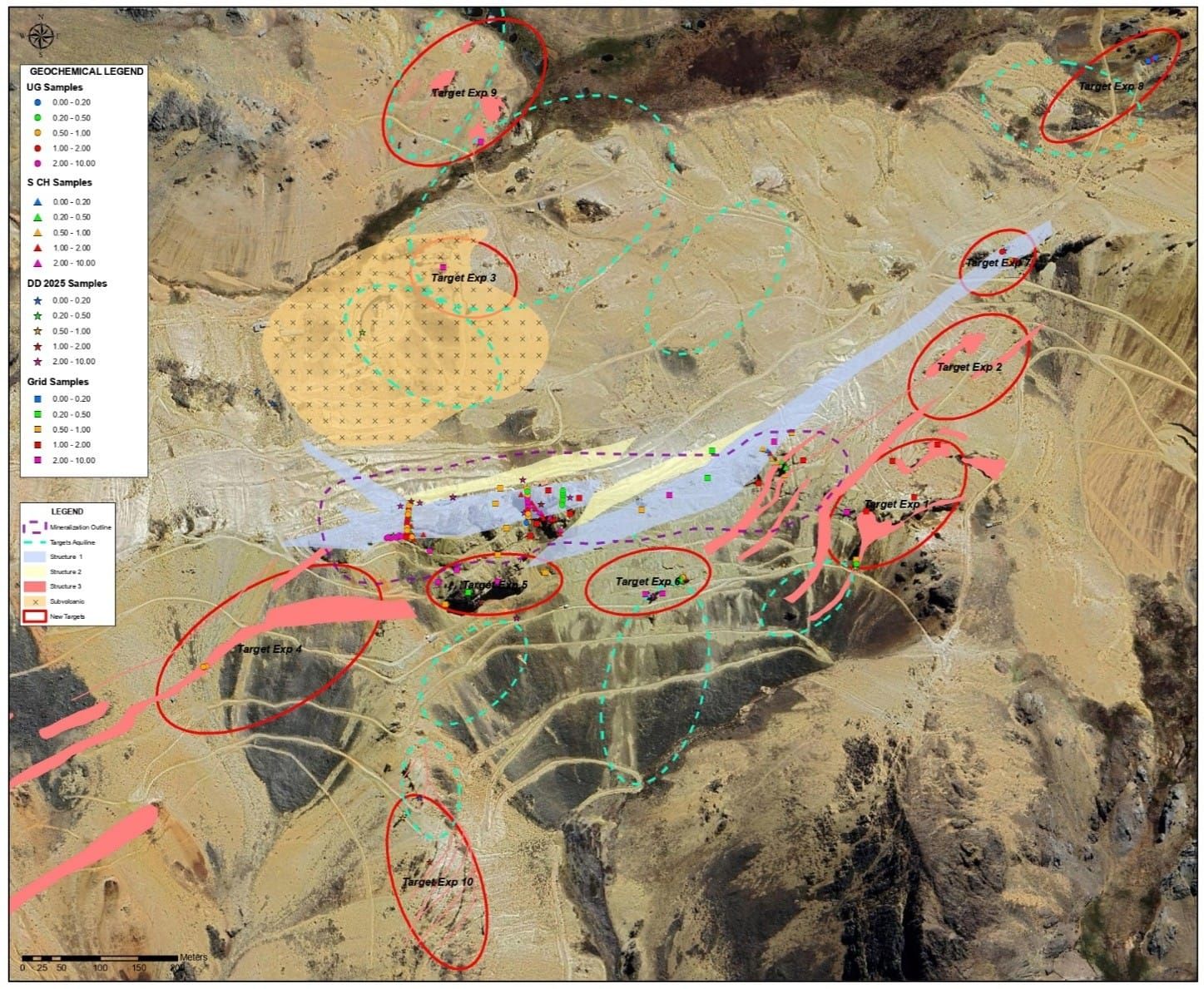
Thirteen underground workings have been excavated at Pico Machay since 2020, according to the release, of which eleven have been mapped and sampled. Xali Gold says all eleven expose gold mineralisation and alteration typical of a high-sulphidation epithermal system, including vuggy silica and advanced argillic alteration — textures produced by acidic fluids leaching the host rock, common in that deposit type. The mapped workings span about 1.35 kilometres northeast-southwest along the main structural trend and roughly 825 metres across it. The historical resource itself has a surface footprint of about 750 metres by 150 metres.
Results from the outlying workings were narrower. UG Channel 8, some 800 metres northeast of the resource centre, returned 1.18 g/t over 4.3 metres. UG Channel 9 gave 2.10 g/t over 1.35 metres in vuggy silica. At UG Channel 10 in the southwest, three samples ran between about 0.68 and 4.14 g/t.
On targeting, the company now defines ten exploration targets, four of which overlap with nine previously outlined by Aquiline Resources. The remaining five Aquiline targets are to be reviewed later.
Chief executive Joanne Freeze, who also signed off on the technical disclosure as the qualified person, said several of the newly sampled areas fall outside the scope of the coming resource update.
That update is the next milestone. The stated purpose of the sampling was to validate and potentially upgrade the historical estimate, which is not a current mineral resource under Canadian disclosure rules until reclassified. The release gives no timing for the update, and no cash, spending or drilling budget figures.
Source: GlobeNewswire
This article is journalism, not investment advice. It is not an offer or solicitation to buy or sell any security. Micro-cap and penny stocks carry a high risk of loss, including illiquidity and dilution. Do your own research.